

When Restraint Becomes Strategy—and Strategy Becomes Liability
The "Putin Script": Is Iran Replicating Russia's Strategic Mistakes?

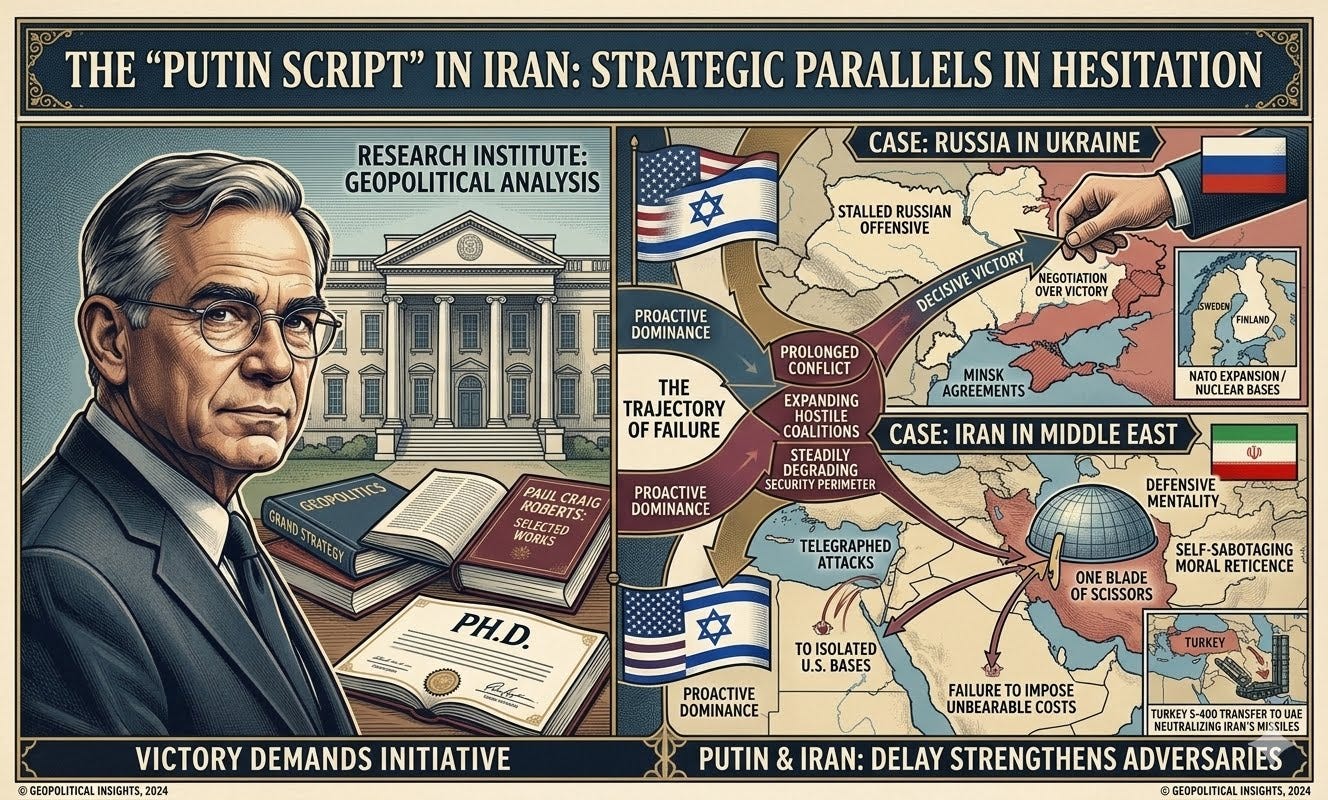
An analysis of the strategic parallels between Vladimir Putin’s conduct in Ukraine and Iran’s behavior in its conflict with Israel and the United States reveals a striking commonality:
Both nations have repeatedly traded military initiative for diplomatic caution. Geopolitical observers and foreign critics—most notably American political economist Paul Craig Roberts—argue that Tehran is systematically replicating Moscow’s critical geopolitical missteps.
According to Roberts, by allowing hostile coalitions to grow stronger over time, both Moscow and Tehran have trapped themselves in a reactive cycle. Unless Iran abandons this hesitant, defensive framework, it risks following the exact strategic trajectory attributed to Russia: a permanently prolonged conflict, expanding enemy alliances, and a steadily eroding security perimeter.
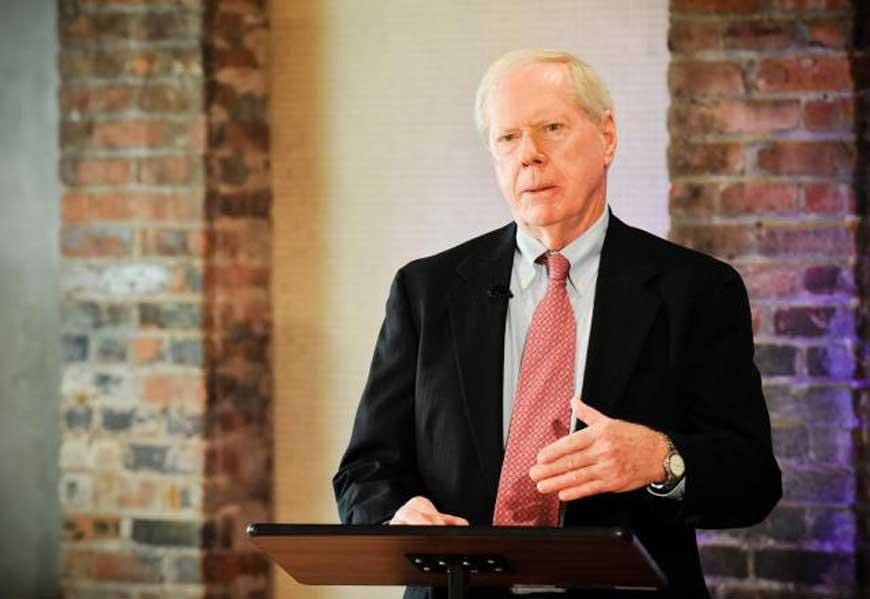
Paul Craig Roberts is an American political economist, author, and former government official. He earned his Ph.D. in economics from the University of Virginia before serving as Assistant Secretary of the Treasury for Economic Policy in the Reagan administration, where he was a principal architect of supply-side economics (”Reaganomics”). Transitioning to media, he worked as an associate editor and columnist for The Wall Street Journal and wrote widely syndicated columns for Business Week, Scripps Howard News Service, and Creators Syndicate. Today, he is a prominent independent geopolitical analyst and critic of Western foreign policy.
The core of Roberts’ critique—frequently echoed by domestic observers in Moscow and Tehran who are often inaccurately labeled “hardliners” by Western media—identifies seven structural vulnerabilities shared by both countries:
1. “Negotiation Instead of Victory”
Roberts argues that both Moscow and Tehran consistently substitute negotiations, ceasefires, and diplomatic signaling for decisive military actions.
Russia’s Pattern: Putin repeatedly sought diplomatic exits (e.g., the Minsk agreements and security talks with NATO). These pauses allowed Ukraine and the West to rearm while Russia failed to enforce its own “red lines.”
Iran’s Parallel: Tehran routinely accepts ceasefires, engages in prolonged talks, and issues warnings rather than executing decisive kinetic responses.
The Strategic Cost: Negotiations provide adversaries time to strengthen while placing political constraints on the party seeking peace.
2. The Defensive Mentality
A central flaw in both governments is an inherently defensive mindset that surrenders the strategic initiative.
Reactive Postures: Russia consistently reacts to Western escalations rather than seizing control of the narrative. Similarly, Iran prepares to absorb incoming strikes instead of pre-emptively imposing costs.
The One-Blade Metaphor: Roberts notes that Iran possesses only “one blade of the scissors”—the defensive capability—while lacking the offensive blade necessary to force a favorable end to the conflict.
3. Self-Sabotaging Moral Reticence
Both nations place excessive emphasis on securing international moral legitimacy—a posture their adversaries perceive as strategic weakness rather than a virtue.
Russia’s Calculated Restraint: Moscow opts for a protracted war of attrition, structurally limiting its kinetic operations to protect its own soldiers and avoid widespread civilian casualties on the opposing side. Furthermore, Russia consistently seeks diplomatic and legal recourse; for instance, Moscow called for an international investigation into the Bucha massacre—for which it was blamed—only to face rejection from Western powers.
The Adversary’s Contrast in Ukraine: Conversely, Ukrainian forces—fully armed, trained, and logistically supported by NATO—demonstrate little regard for civilian infrastructure. Following the 2014 coup against Ukraine’s democratically elected government, the new Kyiv regime routinely shelled the predominantly Russian-speaking Donbas region, targeting marketplaces and residential neighborhoods.
Iran’s Ideological Boundaries: Tehran adheres to strict religious and ethical constraints that blunt its military efficacy. Iran actively warned Qatar ahead of a strike on a shared gas field to ensure civilian workers could evacuate, and issued similar advance warnings before striking northern Israel to allow populations to flee. Tehran deliberately avoids targeting critical infrastructure like desalination plants—which would instantly cripple Israel and the Gulf States—viewing such total warfare as a sin. This aligns with its official religious fatwa strictly banning the production and deployment of nuclear weapons.
The Historical Precedent of Restraint: This religious self-restraint dates back to the Iran-Iraq War. When Saddam Hussein’s Western-backed regime utilized German-supplied chemical weapons to kill and maim over 100,000 Iranian combatants and civilians, Iran’s religious leadership flatly rejected demands for chemical retaliation on moral grounds.
The Adversary’s Contrast in the Middle East: In stark contrast, Iran’s adversaries operate without such operational scruples. They maximize kinetic damage across both military targets and civil society, leveling entire apartment complexes, schools, medical facilities, and places of worship.
The Rhetoric of Restraint: Roberts dismisses defensive platitudes like Iran’s “We don’t attack people; we only defend ourselves” as fundamentally counterproductive in modern warfare.
The Adverse Effect: Western powers and their proxies remain entirely unpersuaded by asymmetric moral restraint. By avoiding escalatory dominance to appear responsible, both Putin and the Iranian leadership achieve the opposite effect—emboldening their adversaries to push further.
4. Failure to Impose Unbearable Costs
A core principle of military strategy is that conflicts only end when unbearable costs are imposed on the opponent. Both regimes fail this metric.
Iran’s Missteps: Tehran telegraphs missile attacks in advance, minimizes civilian casualties, targets isolated U.S. bases instead of hitting Israel directly, and leaves Saudi infrastructure intact. This allows Israel to operate while bearing minimal direct costs.
Russia’s Missteps: Putin consistently avoids aggressive, asymmetrical actions that would significantly raise the stakes for NATO or Ukraine.
5. Delay Strengthens the Enemy
Time is a finite strategic asset. Both governments are actively giving it away to their disadvantage.
The Anti-Russia Coalition: Prolonged delays allow NATO to deepen its involvement, send advanced weaponry to Kyiv, and harden Western political commitment.
The Anti-Iran Coalition: Delays drive Arab states closer to Washington and allow regional air defenses to mature. This vulnerability is highlighted by potential diplomatic maneuvers, such as Turkey transferring its Russian-made S-400 systems to the UAE—a de facto Israeli ally . Furthermore, a dragged-out conflict allows adversaries time to mobilize Saudi Arabia and Pakistan against Iran.
6. The Oligarch Constraint
Throughout his writings and interviews, Roberts introduces a domestic economic layer to explain Russia's strategic paralysis. He argues that the Kremlin is heavily constrained by oligarchic interests, noting that these elites still cling to the hope that the West will eventually lift restrictions and allow them to resume international business. While Roberts suggests this dynamic may have parallels in other heavily sanctioned nations, critics argue he overestimates their current leverage; the immense, overt political power Russian oligarchs wielded during the 1990s has significantly diminished during Putin’s presidency. Nevertheless, his analysis highlights a potentially powerful domestic constraint:
Elite Influence: Roberts contends that Putin frequently prioritizes the financial and commercial interests of Russia’s economic elite over the execution of an outright, uncompromising military victory.
Economic Motives: Rumored defense liquidations—such as the potential transfer of S-400 anti-aircraft systems to the Gulf States—indicate that key economic elites still harbor hopes that strategic concessions will pave the way for sanctions relief and restored access to Western markets. In Roberts’ view, Putin’s military options remain tethered to these domestic financial interests.
7. Victory Demands Initiative
Ultimate military strategy reduces to a simple reality: the side willing to deploy decisive, pre-emptive, and overwhelming force dictates the geopolitical outcome.
The Geopolitical Divide: The United States and Israel fully master this proactive dynamic. Conversely, Russia and Iran cling to the flawed belief that diplomacy, legal appeals, and strategic restraint can substitute for absolute military initiative.
The Trajectory of Failure: Roberts predicts that unless Tehran abandons “Putin’s script,” it will face the exact strategic degradation currently impacting Russia: a permanently prolonged conflict, expanding hostile coalitions, and a steadily eroding security perimeter.
The Cost of Russian Delay: Moscow’s hesitation has already resulted in severe geopolitical blowback. A prime example is Finland and Sweden joining NATO and granting consent to station nuclear weapons on their soil, bringing an existential threat directly to Russia’s borders.
The Cost of Iranian Delay: Similarly, Tehran’s reluctance to establish immediate escalation dominance allows its adversaries time to neutralize its core defense architecture. If Turkey ultimately transfers the advanced S-400 air defense system to Gulf states like the UAE, Iran’s primary strategic deterrent—its ballistic missile stockpile—could be rendered largely ineffective.
Ultimately, this strategic critique deserves serious attention: While the United States and Israel wage wars at will to project power, Russia and Iran stand on the geopolitical chopping block. They must learn to fight for their very survival — because their adversaries have nothing less than their complete destruction or dismemberment in mind.
▪ ▪ ▪
What are your thoughts on this analysis, Douglas Macgregor, Scott Ritter, Larry C Johnson, Alastair Crooke at Conflicts Forum ?
▪ ▪ ▪
Germany’s Eternal Moral Finger: Hypocrisy, History, and the Road to the Next Great War
Why Germany, not Russia, has become Europe’s most dangerous nation (again)
Inconvenient Truths About NATO That Their Mainstream Media Partners Don’t Want You To Know.
And an Unnoticed, Resurgent Revanchism in Germany
And why bloodshed could have been avoided but ultimately was not intended to be.
How the EU’s energy policies cripple its industry while boosting Asia’s rise
Ukraine’s Collapse and Russia’s Strategic Dilemma: A Critical Analysis
The Risks of a Failed Ukrainian State, Europe’s Militarization, and Russia’s Fears of Perpetual Conflict
The Ukraine Conflict: “Diplomacy” as a Repeating Loop and Russia’s Strategic Advantage
The West negotiates with itself, not with Russia
NATO Lost in Ukraine—Now It Eyes Taiwan
NATO has lost its proxy war—or more precisely, its implementation war—in Ukraine. Now it is preparing for a new one, this time in Taiwan.
A Nation’s Rogue Leader Is Willing to Provoke Deadly Retaliation
strategy but
The Snapback of Sanctions: Escalation Against Iran
After years of violating their own commitments, the US and Europe are projecting their behavior onto Iran in order to pave the way for the next conflict.
The Architecture of a Crisis Manufactured by Hostile Foreign Powers
An Exclusive Evidence-Based Exposé on the Hidden Forces, Intelligence Networks, and Propaganda Machinery Fueling Unrest in Iran — Framed by the West as a ‘Popular Uprising’.
The New York Times shatters the propaganda myth of an Iranian popular uprising
A rare correction from a major outlet—and a turning point in the discourse on Iran
Washington promised North Korea a way out—and reneged. Now Iran faces the same collapsing framework of threats and false hope.
The truth about Iran that mainstream media is desperately hiding from you.
Beyond the ‘Oppressed Women’ – The Big Lies about Iran
Examining the Full Spectrum of Western Misrepresentations About Iran: From Social Gains to Leadership Principles, Minority Rights, and Open Discourse in the Islamic Republic
The Making of a Nemesis: How the United States Created the Iran It Now Fears
America’s 70-Year Campaign Against Iran: From Destroying Democracy to Engineering Collapse—And Why the Next Version Could Be Even More Dangerous
▪ ▪ ▪
Felix Abt is an entrepreneur, author and travel blogger, living in Asia.
With his articles, he tries to make a modest contribution to debunking the omnipresent propaganda of the mainstream media for those who don’t have the time (and that’s most people) to do the research to see through it.
https://www.henrymakow.com/ provides explanation why Russia doesn't win the (proxy) war with NATO in the Ukraine, Iran won't eliminate its enemies, and Israel can continue genocide with no more than a little verbal protest. The site is regularly under attack or getting hacked, suggesting "something certain authorities want to hide".
The summary is that most heads of state are members of the same club "we never can get membership of" (paraphrasing George Carlin).
That club has realized long ago the resistance of populations against globalism so its policy has become a decline of the global economy to such an extent that people will beg for a NWO.
From that perspective, the assault on fuel, fertilizer, helium availability etc. makes sense.
Thank God, it's Putin and not such armchair warmongers (-psychologists) like Roberts ...