

The Perfect Vassal State
Why Nationalism In The Philippines Only Comes Into Play When The Invader Is Not American.

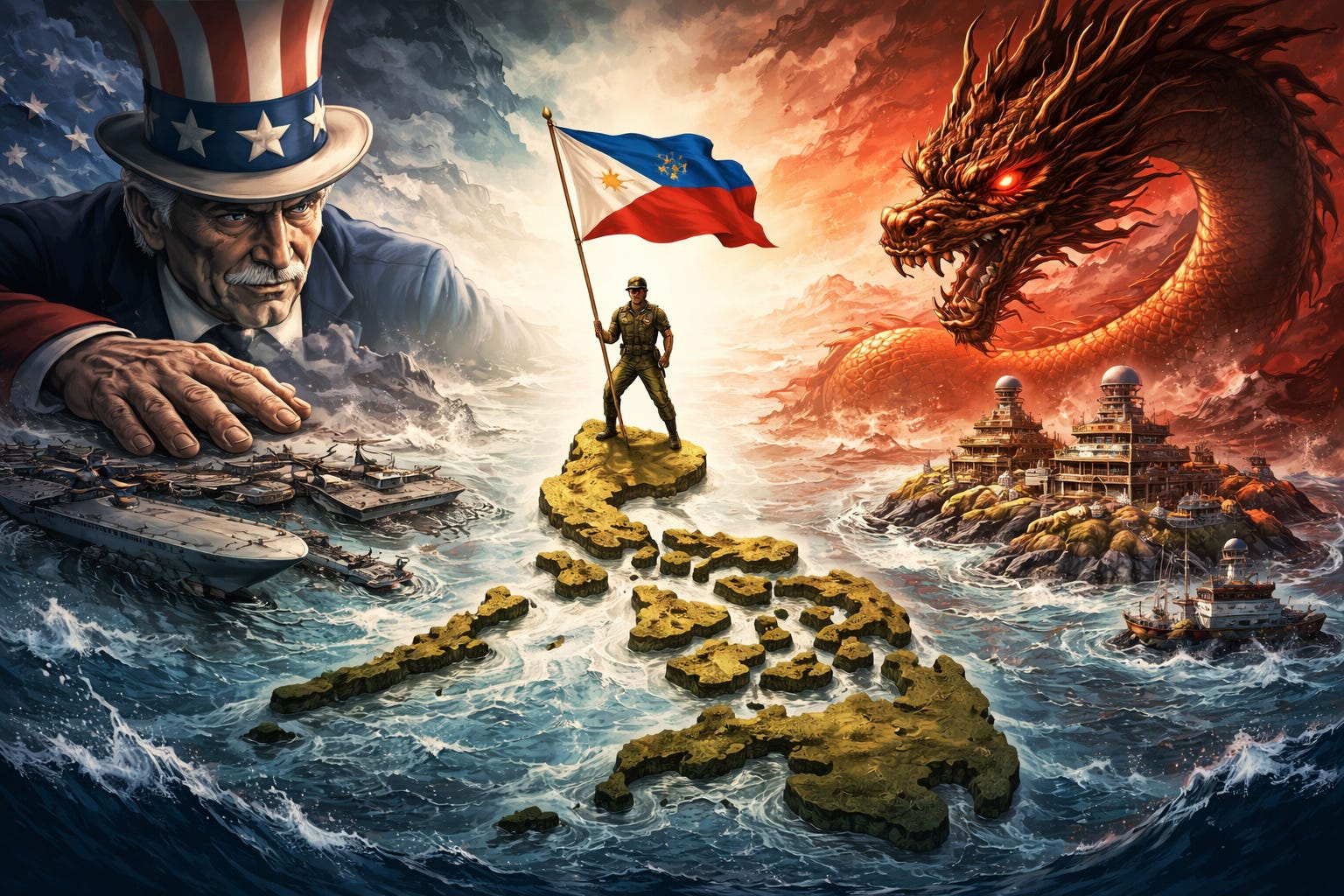
For nearly seven decades, the Philippines hosted a foreign military presence so vast it shaped entire regions, economies, and political structures. Yet during all those years, there was barely a whisper of national outrage. No mass protests. No viral campaigns. No widespread panic over sovereignty.
But in 2012, when China took control of Scarborough Shoal, the reaction was instantaneous and explosive. Social media erupted. Commentators—professional and self-appointed—filled timelines with demands for territorial defense. Ordinary citizens rallied under slogans of nationalism.
This stark difference in reaction—decades of silence toward United States, sudden fury toward China—reveals a deeper truth about the modern Filipino psyche, one shaped by history, power, class, and a century-long relationship far more intimate than most are willing to admit.
This is not just a story about geopolitics.
It is a story about identity—manufactured, inherited, and defended.
I. The Long Shadow of “Benevolent Assimilation”
To understand the modern double standard, we must return to the foundational trauma that shaped Philippine–U.S. relations: the transition from Spanish to American rule at the turn of the 20th century.
When Spain lost the Philippines, it sold the archipelago to the United States for $20 million in the Treaty of Paris (1898)—without consulting a single Filipino. The resulting Philippine–American War (1899–1902) killed an estimated 200,000 civilians. Entire towns in Batangas and Samar were razed in “reconcentration” campaigns.
Yet American policy framed the occupation not as conquest, but as uplift.
President William McKinley famously spoke of “benevolent assimilation,” claiming that Filipinos were not ready to govern themselves. Soon after, the term “little brown brothers” entered official and popular discourse—a paternalistic label that simultaneously infantilized Filipinos and elevated Americans as saviors.
This narrative was not incidental; it was structural.
American colonization built the Philippine education system, media industry, legal codes, and bureaucracy. English became the language of advancement. American heroes replaced local ones in textbooks. Children grew up reciting American civic ideals long before they learned the full story of their own revolution.
In short, the U.S. didn’t just govern the Philippines.
It reshaped its worldview.
II. Bases Without Protest: The Postwar Military Presence
After World War II, independence was granted—but only partially. The Philippines inherited a republic with American fingerprints all over it, from the constitution to the economic system. More importantly, the U.S. maintained massive strategic footholds across the archipelago.
Clark Air Base and Subic Naval Base became two of the largest American military installations in Asia. For decades, these bases operated like extraterritorial enclaves—American land in all but name.
Filipinos working inside were subject to different rules.
Surrounding communities became dependent on base economies.
Crimes committed by foreign servicemen often disappeared into diplomatic limbo.
And yet, this vast, long-term presence generated little national resistance for most of the 20th century. Protests emerged only in the late 1980s and early 1990s—and even then, elite and political factions were sharply divided. Many believed American bases were essential to security and modernization.
Sovereignty, somehow, was negotiable.
This normalized acceptance paved the way for the Visiting Forces Agreement (VFA) in 1998—a treaty granting American troops legal immunity from prosecution under Philippine law. Even controversial cases, including incidents involving violence against Filipino citizens, sparked only limited outrage.
When VFA critics spoke up, they were often drowned out by fellow Filipinos accusing them of “anti-Americanism.”
III. Scarborough Shoal: The Awakening on Social Media
Contrast this with the reaction when China seized Scarborough Shoal in 2012.
In days, the issue dominated social media feeds. Nationalism surged. Artists created protest posters; influencers became foreign policy experts overnight. Anti-China sentiment spread across radio shows, newspapers, and online communities.
Suddenly, sovereignty was sacred.
Foreign encroachment was intolerable.
A reef 200 kilometers offshore became a national symbol.
But where was this energy when American troops operated with legal immunity on Philippine soil?
Where was the outrage when Filipino soldiers had limited jurisdiction inside their own country?
Where was the indignation when American bases influenced local economies, politics, and communities for decades?
The inconsistency is telling.
IV. The U.S.-Educated Elite and the Soft Power Pipeline
One of the most critical, yet least discussed, forces driving this asymmetrical reaction lies in the country’s leadership class.
For over a century, a significant portion of the Filipino elite—politicians, business leaders, bureaucrats, journalists—have studied in the United States. From Ivy League campuses to state universities, thousands of young Filipino scholars, diplomats, and technocrats were trained in American institutions that shaped their worldview.
These individuals returned home fluent in English, deeply connected to U.S. networks, and socialized into American political and cultural norms. Many maintain lifelong ties through alumni associations, fraternity networks, and professional organizations.
The result is a leadership class that, consciously or not, often sees the Philippines through an American-centric lens:
U.S. foreign policy becomes the default framework.
U.S. military presence is seen as stabilizing.
U.S. diplomatic positions are treated as authoritative.
Criticism of American influence is equated with being irrational or “leftist.”
Geopolitical alignment with Washington is viewed as common sense, not a strategic choice.
Some Filipino elites even speak as if the Philippines functions as an appendage—or responsibility—of the United States, rather than an independent country.
This mentality trickles down through media, bureaucracy, and academia, shaping public sentiment in ways many ordinary Filipinos barely recognize.
V. The China Threat vs. The American Protector Narrative
This elite framing fits neatly into the broader colonial narrative inherited from the 20th century:
China is depicted as the unpredictable neighbor.
The United States is portrayed as the stable protector.
Asian aggression is alarming; Western aggression is manageable.
China’s moves trigger nationalist panic; America’s moves trigger diplomatic justification.
The result is not just a double standard—it is a form of identity-based foreign alignment.
People do not merely choose sides.
They feel them.
American influence has been framed as aspirational, modern, and benevolent. Chinese influence, by contrast, has been painted as unfamiliar, authoritarian, and threatening. These narratives often have less to do with real policy differences and more to do with decades of cultural conditioning.
VI. What the Double Standard Reveals
When Filipinos demand China “get out of our waters,” they are expressing a legitimate concern about territorial encroachment.
Yet when these same voices tolerate—or even welcome—the presence of American soldiers with full legal immunity not only at sea but across the entire country, this double standard reveals something deeper:
Sovereignty matters only when violated by certain foreigners.
Nationalism activates selectively.
Foreign military presence is acceptable depending on the passport involved.
The idea of “protection” is racialized and historicized.
Colonial mentality does not disappear with independence.
It embeds itself in institutions, education, and class structures.
It shapes reactions before thoughts even form.
VII. The Real Occupation
The Philippines is not unique in this dynamic. Postcolonial nations across Asia, Africa, and Latin America confront similar psychological legacies.
But the Philippine case is particularly vivid because:
American influence was unusually deep and intimate.
Elite networks maintain strong U.S. alignment.
Language, media, and culture continue reinforcing American centrality.
Public sentiment mirrors old hierarchies of trust and fear.
In a way, the archipelago is still living inside the mental architecture built during the colonial period.
And that may be the most enduring occupation of all.
Footnotes
On the Treaty of Paris (1898), in which Spain ceded the Philippines to the United States for $20 million:
See: Treaty of Paris (1898), U.S. Department of State archives.Civilian casualty estimates of 200,000 or more during the Philippine–American War (1899–1902) derive from demographic analysis conducted by historian John Gates and corroborated in “War and Peace in the Philippines,” Journal of Asian Studies.
President William McKinley’s “benevolent assimilation” policy is documented in the Benevolent Assimilation Proclamation (1898), published in the U.S. Congressional Record.
The term “little brown brothers” was popularized by U.S. Governor-General William Howard Taft, later President of the United States.
Source: Stanley Karnow, In Our Image: America’s Empire in the Philippines.The shaping of Philippine education, governance, and media under American rule is extensively documented in:
Glenn May, Social Engineering in the Philippines;
Benedict Anderson, Cacique Democracy in the Philippines.For U.S. base history, see archival documentation from the Subic Naval Base and Clark Air Base maintained by the U.S. Naval History and Heritage Command.
On crimes involving U.S. servicemen in the Philippines during the postwar base era, a key reference is the Senate of the Philippines’ 1991 Hearings on the Bases Treaty.
The Visiting Forces Agreement (VFA), signed in 1998, is accessible via the Department of Foreign Affairs of the Philippines. Articles V–VI outline jurisdiction and legal immunity clauses.
On the 2012 Scarborough Shoal standoff (also known as Bajo de Masinloc), see reports by:
– Asia Maritime Transparency Initiative (CNAS)
– Philippine Department of Foreign Affairs statements (2012)Social media escalation and nationalist reaction post-2012 are analyzed in Nicole Curato’s work on Philippine digital publics: Democracy in a Time of Misery.
The long-standing pattern of U.S.-educated Filipino elites shaping national policy appears in Alfred McCoy’s Policing America’s Empire and Renato Constantino’s The Miseducation of the Filipino.
On China being framed as an “unpredictable neighbor” and the United States as a “protector,” see Richard Heydarian, Asia’s New Battlefield, which examines Philippine geopolitical psychology.
For comparative postcolonial nationalism and selective anti-foreign sentiment in Asia and Latin America, see Frantz Fanon, The Wretched of the Earth, and Partha Chatterjee, The Nation and Its Fragments.
The notion that the Philippines still lives inside an inherited “colonial mental architecture” echoes Vicente Rafael’s interpretation in White Love and Other Events in Filipino History.
▪ ▪ ▪
Disclaimer: The author did business in the Philippines for many years and lived in Manila for a period of time.
▪ ▪ ▪
Related:
▪ ▪ ▪
Stay connected and informed—join me on Substack:

▪ ▪ ▪
Felix Abt is an entrepreneur, author and travel blogger living in Asia.
With his articles, he tries to make a modest contribution to debunking the omnipresent propaganda of the mainstream media for those who don’t have the time (and that’s most people) to do the research to see through it.
▪ ▪ ▪