


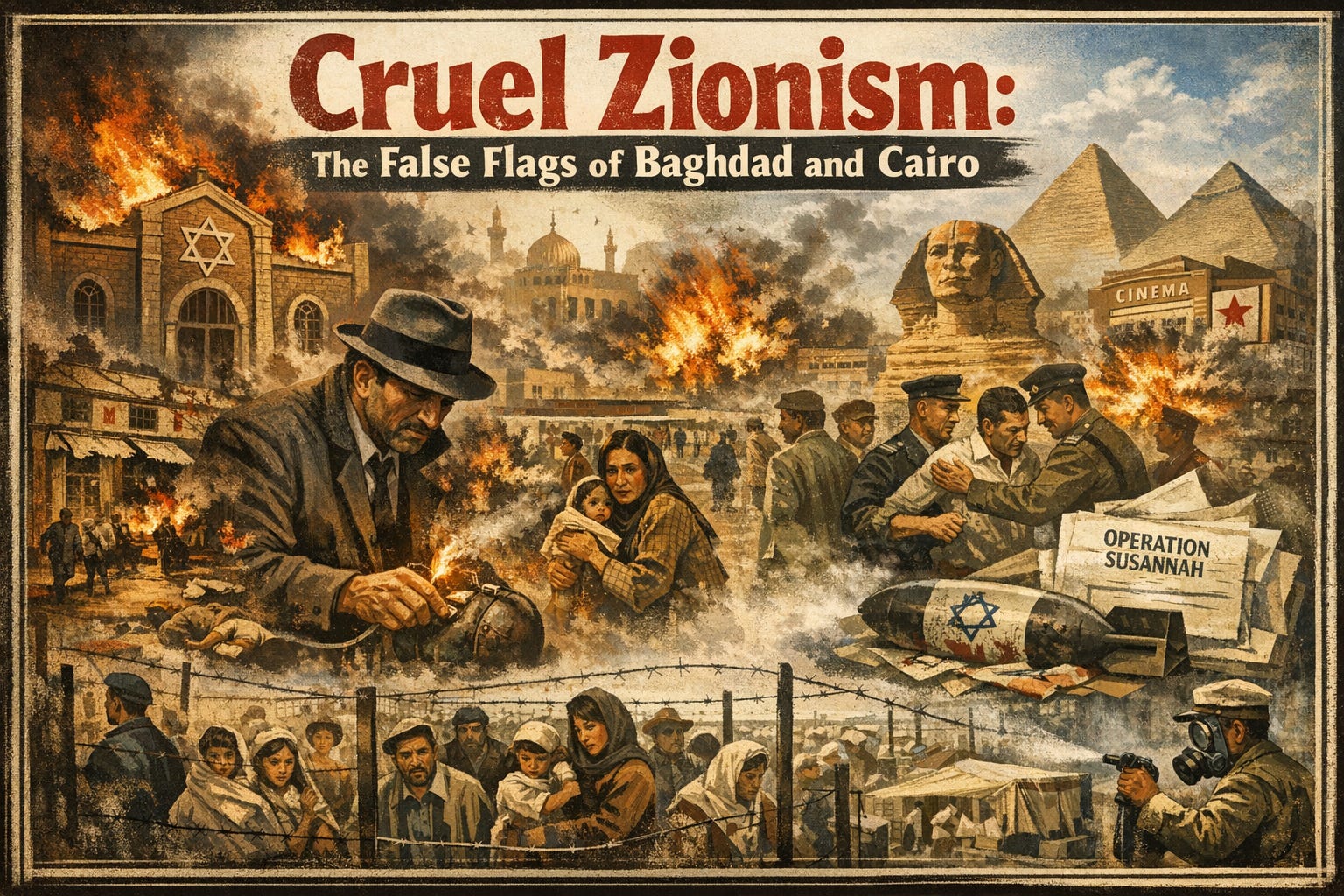
When Israel is described as a European colonial project, the Zionist standard rebuttal is demographic: “Nearly half of Israeli Jews are Mizrahi (from the Middle East and North Africa).” While factually true, this response often glosses over a more uncomfortable question: How and why did these ancient communities relocate to the nascent settler state?
Following the 1917 Balfour Declaration, the Zionist movement faced a demographic crisis. Most European Jews sought refuge in the Americas rather than the Levant. To build a viable state, a massive labor force was required. The solution lay in the Jewish communities of the Arab world—Yemen, Iraq, and Morocco—who had lived in the region for millennia.
Yet, early Zionism was an Ashkenazi-led movement steeped in the prejudices of its time. Leaders like David Ben-Gurion were vocal about their “civilizing” mission; Ben-Gurion notoriously expressed concerns over the “Levantinization” of the state, at one point comparing Sephardi and Mizrahi immigrants to “savages” or the enslaved populations of the American South. This Orientalist lens framed Mizrahi Jews as a necessary labor source, but culturally “backward.”
Furthermore, many of these communities initially resisted the Zionist call. The Iraqi Jewish elite, deeply integrated into Baghdad’s economic and cultural fabric for over 2,500 years, viewed themselves primarily as Iraqis of the Jewish faith. Zionist emissaries often found them “stubbornly” attached to their homes, unmoved by nationalist appeals. When ideological persuasion failed, tactics shifted toward what some historians term “cruel Zionism”—the deliberate destabilization of Jewish life to force emigration.
The most flashpoint example is the 1950–1951 Baghdad bombings, which targeted Jewish landmarks including the Masuda Shemtov Synagogue and a popular Jewish-owned coffee shop. While Israel has officially denied involvement for decades, research by British-Israeli historian Avi Shlaim—himself an Iraqi-born Jew—concluded that at least three of these bombings were the work of a Zionist underground operative. These attacks were calculated to “shatter the sense of security” within the community, effectively manufacturing the panic that led to the mass transfer of 110,000 Jews to Israel.
This pattern of disrupting integrated Jewish life continues into the present day. The existence of a prosperous, state-protected Jewish community in Iran remains a direct challenge to the narrative that Jews can only find safety within a Zionist state. The stability of Iranian Jewry disrupts expansionist visions of a “Greater Israel” by proving that Jewish life can flourish in the heart of the Middle East.
This tension reached a breaking point on April 7, 2026, when the Rafi-Nia Synagogue in central Tehran—a cornerstone of the Khorasan Jewish community—was completely destroyed. While the Israeli military characterized the destruction as “regretful collateral damage” from a strike on a nearby military target, military experts have largely rejected this claim. Given the pinpoint accuracy of modern precision-guided munitions, critics argue the strike was a deliberate message: an attempt to physically erase the evidence of a Jewish life that exists outside of, and in opposition to, the Zionist project.
The destruction of this ancient holy site, with Torah scrolls left buried under the rubble, has intensified claims that the ongoing military campaign increasingly targets the cultural and religious fabric of the region’s native populations.
This tactic of leveraging fear is a recurring theme, stretching from the early days of the state to the present. Similar “false-flag” operations were attempted in Egypt, most famously the 1954 Lavon Affair (Operation Susannah).
Zionist agents also skillfully leveraged the genuine rise in anti-Semitism fueled by Nazi German influence, such as the 1941 Farhud pogrom in Baghdad. By framing these tragic events as proof that Jewish life in the diaspora was no longer viable, they presented the nascent Israeli state as the only possible refuge.
In Yemen, following the 1947 Aden riots, the “Operation Magic Carpet” airlift was similarly characterized as a desperate rescue mission. Yet, the “redemption” promised to these ancient communities was often hollow; upon arrival, Yemenite Jews were met with paternalistic disdain and subjected to degrading treatment—most infamously being “sprayed” with DDT like livestock as part of a state-mandated “civilizing” process.
The “dream of redemption” often ended in the harsh reality of the Ma’abarot (transit camps). Surrounded by barbed wire and watchtowers, these camps were eerily reminiscent of the concentration camps many had hoped to escape. By 1951, 80% of those in these camps were Mizrahi. While Ashkenazi immigrants were usually fast-tracked to permanent housing, Mizrahi families were often left in tents for over a decade. Most tragically, the Yemenite Children Affair saw over 1,000 babies “disappear” from these camps; families were told their healthy children had died, yet they were never shown bodies or graves, leading to decades of allegations that the children were abducted for adoption by Ashkenazi families.
This history suggests that the Mizrahi presence in Israel was not a spontaneous “homecoming,” but the result of a calculated mobilization. Ancient Middle Eastern Jewish life was fundamentally uprooted to serve the demographic requirements of the Zionist state that viewed these communities as “human material.” It represents a recurring pattern in Israeli statecraft: the use of insecurity—sometimes organic, sometimes manufactured—to sever the ties between Jews and their native countries.

Zionists are world champions at false-flag operations, ranging from bombings of synagogues in Egypt and Iraq—carried out in the name of Arabs—to everyday, fake antisemitic acts staged by them.
By portraying the diaspora as a place of inevitable peril, the Zionist state positions itself as the only possible sanctuary, often relying on provocations portrayed as antisemitism that is then blamed on local populations to secure its labor force and reinforce a narrative of civilizational conflict.
▪ ▪ ▪
Bibliography:
Primary Sources & Academic Literature
Shlaim, Avi. Three Worlds: Memoirs of an Arab-Jew. Oneworld Publications, 2023. (Essential for the context on the Baghdad bombings and the identity of “Arab Jews.”)
Shenhav, Yehouda. The Arab Jews: A Postcolonial Reading of Nationalism, Religion, and Ethnicity. Stanford University Press, 2006. (Explores the “human material” concept and the ideological uprooting of Mizrahi communities.)
Shohat, Ella. On the Arab-Jew, Palestine, and Other Displacements. Pluto Press, 2017. (Covers Orientalism within Zionism and the “civilizing mission.”)
Black, Ian and Benny Morris. Israel’s Secret Wars: A History of Israel’s Intelligence Services. Grove Press, 1991. (Provides detailed context on the Lavon Affair and early Mossad/intelligence operations in Arab lands.)
Segev, Tom. 1949: The First Israelis. Henry Holt & Co., 1986. (Provides documentation on the Ma’abarot, the use of DDT, and Ben-Gurion’s specific quotes regarding Mizrahi immigrants.)
Gat, Moshe. The Jewish Exodus from Iraq, 1948-1951. Frank Cass, 1997. (Offers a detailed look at the pressures—both internal and external—that led to the Iraqi Aliyah.)
Reports on Specific Historical Events
Madmoni-Gerber, Shoshana. Israel’s Media and the Exclusion of Yemenite Jews: Between Invisibility and Ridicule. Transaction Publishers, 2009. (Detailed research on the Yemenite Children Affair.)
The Cohen-Kedmi Commission Report (2001). Official Israeli state inquiry into the disappearance of Yemenite babies (while controversial, it is a primary reference for the state’s official stance).
Shlaim, Avi. “The Baghdad Bombings of 1950-1951.” The Spectator, June 2023. (Summarizes his archival findings regarding Yusef Basri and the Zionist underground’s role in Iraq.)
Contemporary References (2026 Context)
Middle East Eye / Al Jazeera News Archive (April 2026). “The Destruction of the Rafi-Nia Synagogue: Collateral Damage or Deliberate Target?” (Referencing journalistic coverage of the Tehran strikes).
Human Rights Watch / Amnesty International. Special Report (2026): “Cultural Erasure and the Targeting of Religious Sites in the Iran-Israel Conflict.”
Key Archival Concepts
The “One Million Plan”: The 1944 Zionist executive plan for the mass migration of Jews from Arab and Muslim lands to address the labor shortage.
The Farhud (1941): Documentation from the United States Holocaust Memorial Museum (USHMM) regarding the pogrom in Baghdad and its subsequent use in Zionist recruitment propaganda.
P.S.
What is Zionism? Vanessa Redgrave has the answer: “Zionism is a brutal, racist ideology, like the Nazi ideology. The Zionists are using the same methods as Hitler and the German fascists, the same methods against the Palestinians and the Arab people.”
▪ ▪ ▪
Related:
Exploring the Zohar, the Great Shattering, divine sparks, klipot, and why literalist Kabbalah — including former Chief Rabbi Ovadia Yosef’s statements — claims Goyim exist only to serve Jews.
Epstein and His Like-minded Buddies: Above the Law, Above the Goyim (non-Jews)
When “Jews Are Above the Law” Meets “Let the Goyim Deal in the Real World” – Examining Supremacist Threads Across Religion, Politics, and Elite Abuse Networks
Israel’s war against Iran and its ongoing conquests in the region are turning the Middle East upside down—and will trigger a humanitarian catastrophe under whose weight Europe could collapse.
The Invisible Hand: How Israel Orchestrates the Terror Groups It Claims to Fight
Uncovering why ISIS and Al-Qaeda never attack Israel and how state-sponsored terrorism fuels the “Greater Israel” project—amid a seemingly coordinated media blackout keeping the issue under wraps.
Apartheid In Israel: Then And Now.
Reasons Behind The Incessant Violence
Welcoming Strangers: Early Refugees and the Changing Landscape of 1940s Palestine
How Palestinians opened their homes to new arrivals—Armenians and Jews alike—before the mass immigration and the violent establishment of the colonial Jewish apartheid settler state of Israel
Inside the “Most Moral Army”: An IDF Soldier’s Video of Humiliation and Supremacist Rage
“We’re God’s Chosen People”: IDF Soldier Trampling a Palestinian Woman
America’s Forgotten on the Brink While Trump Wages War for Israel
Tens of Millions Face Hunger and Unaffordable Healthcare at Home—As Billions Flow to an Illegal Strike on Iran That Kills Over 100 Children in a Girls’ School, Under a President Compromised by Epstein
Iran, Israel, and the Geopolitical Chessboard: A Manufactured Crisis
From Nuclear Hysteria to Regime Change, How the Empire Recycles Old Playbooks to Block a New Eurasian Order
Israel’s campaign of high-profile assassinations hasn’t crippled Iran—it’s created a harder, more nuclear-ready opponent to its expansionist project.
Israel’s March Toward Collapse
Renowned Israeli professor Ilan Pappé explains why and how the emerging theocracy is heading toward the abyss.
A War to Topple Iran That Toppled the Non-Proliferation Regime Instead
In the attempt to stop a bomb Iran wasn’t building, Israel and the U.S. have ended the era of nuclear restraint.
How centuries of European hate, guilt, and colonial tricks were vomited onto Palestine.
Christian Zionism Is a Betrayal of Christianity
From Abraham to Christ: The Fulfillment That Zionism Denies
▪ ▪ ▪
Felix Abt is an entrepreneur, author and travel blogger living in Asia.
With his articles, he tries to make a modest contribution to debunking the omnipresent propaganda of the mainstream media for those who don’t have the time (and that’s most people) to do the research to see through it.
▪ ▪ ▪
Thanks for reading Felix Abt’s Substack! Subscribe for free to receive new posts and support my work.
If you found this piece valuable, please consider supporting my work with a monthly or yearly Substack subscription. Your support helps make in-depth research and independent writing like this possible—and allows me to keep bringing you more stories that go beyond the headlines.