Revelation: Repressive China Suppressed A Popular Toy Bear — Or Was It the Western Fake News Media?
From Plush Bears to Media Spins: The Truth About China’s Pooh Saga.
Years ago, when I happened to see a large stall with lots of Winnie-the-Pooh products at the market in a medium-sized Chinese city, I stopped and was amazed. Hadn’t I recently read in the Western media that Winnie the Pooh had been banned in China?
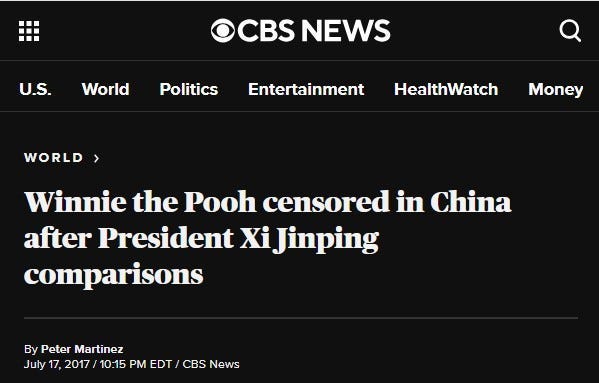
The story of the banned plush bears, T-shirts and other Winnie the Pooh paraphernalia has been in the media ever since. One of the first was the BBC, which “reported” in 2017 that Winnie the Pooh had been banned in China.
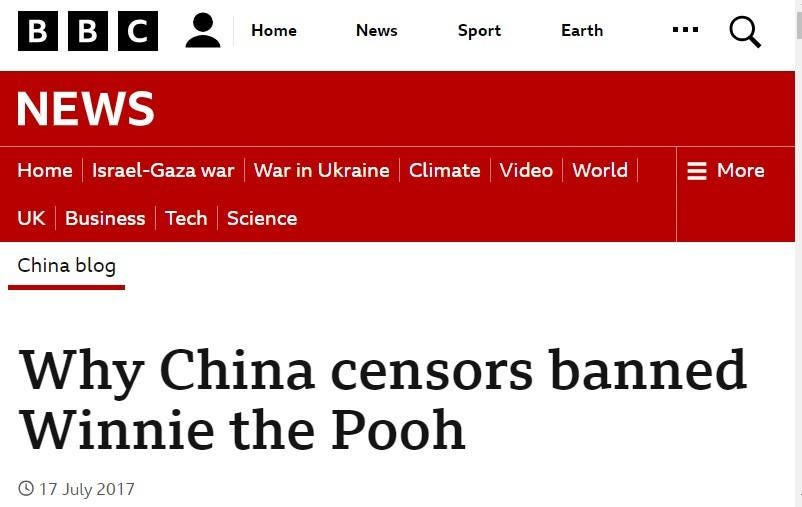
The toy bear that challenged the Chinese president caused a great stir in the Western media and earned their unreserved sympathy.
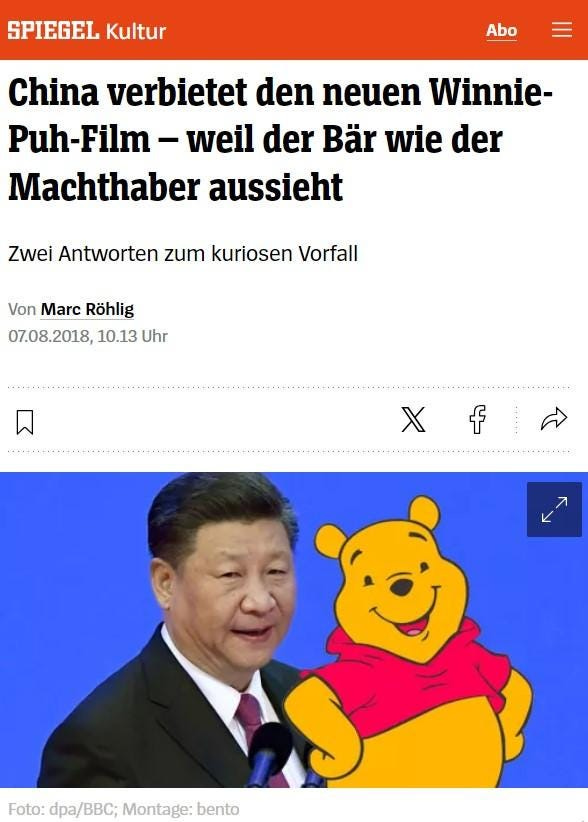
A year later, in 2018, the leading German news magazine Der Spiegel “reported” that the “Chinese ruler” was afraid of Winnie the Pooh and that the cute toy bear should therefore be banned. “Because the bear looks like the ruler“, it said without joking (see screenshot). And the fact that Chinese people with bear-like facial features could be a racist slur didn’t bother the otherwise woke, morality-spouting Spiegel. It made the lofty claim that “images of Winnie the Pooh have long been banned in China — precisely to prevent Xi memes that are critical of the system.”
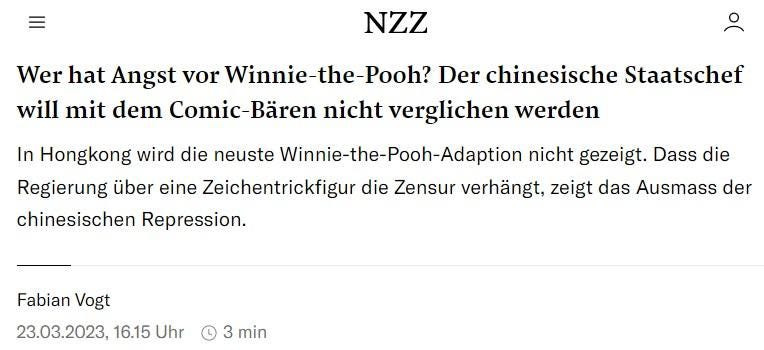
Better late than never: a full five years later, in 2023, the Neue Zürcher Zeitung (NZZ), perhaps the most influential newspaper in the German-speaking part of Europe, also “reported” on the Chinese head of state’s uncanny fear of bears. The NZZ cited the Winnie the Pooh ban as watertight proof of China’s all-encompassing repression (see screenshot).
Winnie-the-Pooh was also banned elsewhere because the bear was accused of being an “inappropriate hermaphrodite” with “dubious sexuality”. As this happened in a Polish and not a Chinese city, it was not worthy of a headline in the Western media.
None of these “reporters” who wrote about the oppression of the bear and its fans in China were on the ground to clarify the matter. Ideological beliefs have the power to replace facts in the media like never before.
Fortunately, today there are social media that not only spread nonsense and untruths like the traditional media, but also truth that cannot be found in the latter.
Foreigners living in China, who consume Western media less for information — that would be a waste of time — and more for amusement, have dared to post Winnie the Pooh on social media, as seen at Chinese markets or on T-shirts worn by Chinese people. And they know that Winnie has even a name in Chinese: 小熊维尼
For example, Lee Barrett, who is British and lives in Shenzhen, recently tweeted photos from a Chinese store selling Winnie the Pooh products (see screenshot).
Jerry Grey, who lives in Guandong Province, saw this electric motorcycle just a few hundred meters from his front door.
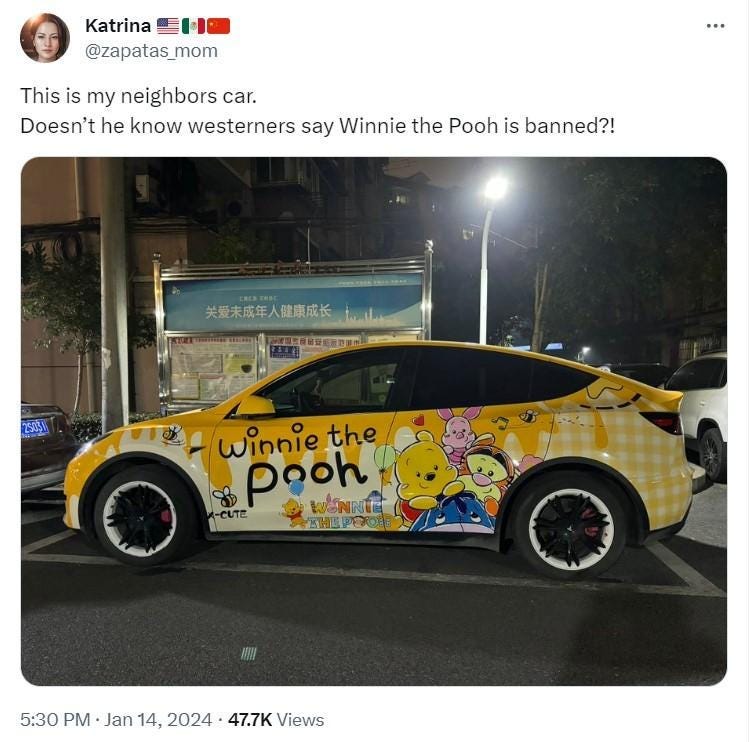
And Katrina, an American living in China, tweeted a picture of her Chinese neighbor’s car painted with Winnie the Pooh (see screenshot).
Of course, the journalists who claim that Winnie the Pooh is banned do not shop online in China like the Chinese do, e.g. on Taobao (picture), and therefore cannot know how convenient it is for the Chinese to have Winnie the Pooh delivered directly to their homes.
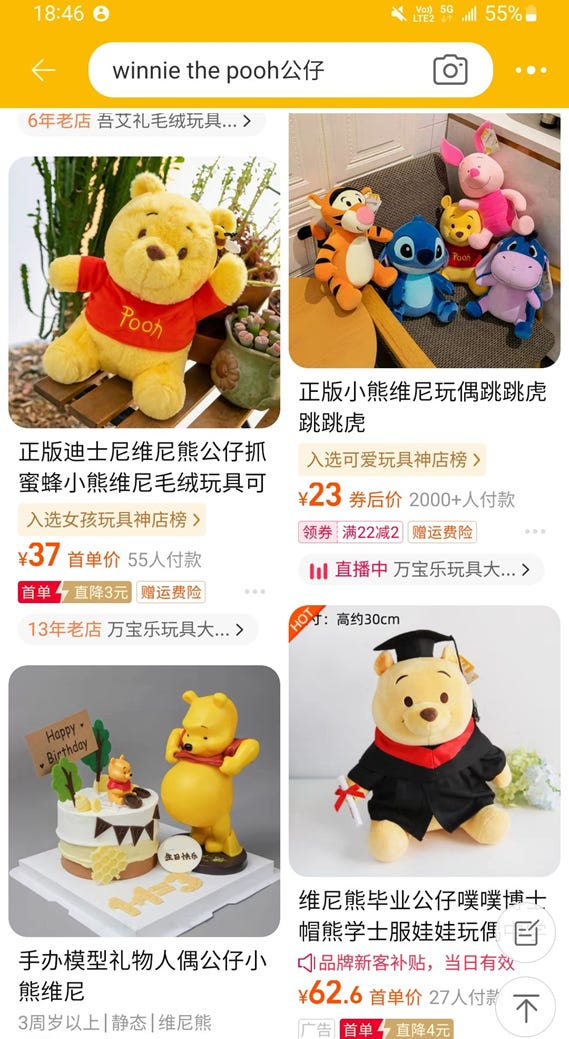
They are so clueless (or pretend to be) that they don’t know that Chinese people can order a warm Winnie hat for cold winters cheaply online, i.e. for 38.8 yuan or less than 6 USD.

But didn’t they visit some shopping centers in China to at least see these vending machines?
The very least they can do is travel to Shanghai or Hong Kong's Disney Land to actually spend time with Winnie.
Where is the repression, dear NZZ? Now a new article with the telling title is probably due: “In unpredictable China, you can’t even rely on repression anymore!“
▪ ▪ ▪
This article was first published by the Asian internet magazine Eastern Angle.
▪ ▪ ▪
Read my related articles addressing Western stereotypes of China:
She Has Three Husbands — Life Outside Lhasa, Tibet
Xizang (Tibet) Today: Vibrant Monasteries, Bilingual Education, and a Living Culture That Challenges Narratives of Cultural Suppression
Everyone Thinks the South China Sea Is About Trade & Resources. They’re Looking at the Wrong Map.
The real story begins 4,000 meters below the surface, where nuclear deterrence, submarine warfare, and great-power competition converge.
The Morality of Power: War, Virtue, and the Pursuit of Harmony in Asian Statecraft
A Cultural Legacy That Measures Power by Restraint, Not Expansion
The Collapse of Nationalist China: Corruption, Military Defeat, and the Limits of American Power
From U.S. Billions to inevitable bankruptcy: how Chiang Kai-shek’s corrupt regime paved the way for Mao’s victory and why the ghost of that lost war still haunts Taiwan today.
Chongqing: Opportunities and Identity on the Move
Beyond the Headlines: How Language and Entrepreneurship are Shaping the Real Lives of China’s Minorities.
From Democracy to Suppression: How Taiwan’s Government is Silencing Opposition
With Mass Arrests, Media Control, and Judicial Crackdowns, is Taiwan Still the “Beacon of Democracy” it Claims to Be?
The Taiwan “Idiocy”: Why Game Theory Rules Out a 2027 Invasion
While the Pentagon warns of a looming 2027 conflict, the strategic “payoff matrix” tells a different story.
Travel Report and Reflections on the Potala Palace, the 50-yuan note, and the true meaning of liberation in Tibet
The Plan to Break Up China: Xinjiang, Separatism, and the Three-State Blueprint
How intelligence agencies, radical groups, and Western narratives converged on a single geopolitical objective
👉 Must read:
Past the Propaganda: Xinjiang as It Really Is
An on-the-ground account challenging stereotypes — meeting Uyghurs, experiencing traditions, and seeing a region beyond the narrative
London High Court: Allegations Of Forced Labour In China’s Xinjiang Province Unproven And Defamatory
Washington’s economic and propaganda war against China suffers a severe setback
Long before the West imagined equal opportunity, China practiced it. The Tang civil service offers lessons for a world torn between Chinese meritocracy and Western plutocracy.
Wu Zetian: The Woman Who Rewrote China’s Rules
From palace intrigues to civil service exams, China’s only female emperor left a legacy that fueled the nation’s rise and still shapes women’s paths to leadership today.
A New Peak of Disinformation: Financial Times Lies that Business is Collapsing in China
Revelation: Repressive China Suppressed A Popular Toy Bear — Or Was It the Western Fake News Media?
Why India Can’t Catch Up to China—Yet
Rapid growth hasn’t closed the gap, but strategic partnerships could give India a turbo boost
China’s Shadow Banking Paradox: The System Everyone Fears—but Without Which China Cannot Live
It’s the massive ticking bomb that everyone can see. Yet, somehow, it hasn’t exploded.
The Quiet Rise of a New Global Payments System
BRICS, CIPS, and the gradual end of the dominance of the US dollar – a fundamental change that the West apparently overlooks – to its own detriment.
Revelation Story: How Germany and Japan Tried to Derail China’s High-Speed Rail Rise
A behind-the-scenes look at sabotage, supply blockades, and how China turned crisis into technological independence.
Inside the Secret Battle Between a Rising China and a Declining Superpower
The Collapse of the “China Collapse” Narrative
I spent several weeks in China, expecting to find signs of a current or impending crisis. Instead, I witnessed a future taking shape at breakneck speed.
Rerouting Global Trade: The Rise of the Eurasian Corridor
Bypassing US Maritime Chokepoints Through Steel and Strategy
China’s Breakthroughs Are Ending Diseases—And Threatening Big Pharma’s Business Model
Meritocracy and shared prosperity drive innovations that Western healthcare systems can’t match.
Oligarchic Rule in the West Contrasts with People’s Representation in Vietnam and China
Vietnam and China Expose the Rot at the Heart of Western “Democracy”
From Guerrilla Wars to Victory Parades: Why China, Russia, and North Korea Stand Together Today
The forgotten role of Chinese and Korean resistance in WWII explains today’s alliances—and why the West keeps misreading them.
China’s Silent Checkmate: How Rare Earths Are Crippling Israel’s Missile Defense
Iran’s missiles are flying. Israel’s interceptors are dwindling. But the real game-changer? China’s hold on rare earths.
Debunking the Myth of China’s “Social Credit” Dystopia
Behind the West’s most persistent political fantasies — and why the truth is more bureaucratic than Orwellian.
Two Competing Systems: China’s Subways Serve People — Western Subways Fail Them
Subways Don’t Lie: China Rising, West Declining
Revelation: Repressive China Suppressed A Popular Toy Bear — Or Was It the Western Fake News Media?
How the Media Misuse Sport as a Propaganda Weapon in the Information Warfare
Western Media Rely on Dubious Sources in Smears Directed Against China
▪ ▪ ▪
If you found this piece valuable, please consider supporting my work with a monthly or yearly Substack subscription. Your support helps make in-depth research and independent writing like this possible—and allows me to keep bringing you more stories that go beyond the headlines.
Felix Abt is an entrepreneur, author and travel blogger, living in Asia.
With his articles, he tries to make a modest contribution to debunking the omnipresent propaganda of the mainstream media for those who don’t have the time (and that’s most people) to do the research to see through it.
▪ ▪ ▪


