

India's Precarious Path
Elite-Driven Policies Favoring the Few While Jeopardizing the Many

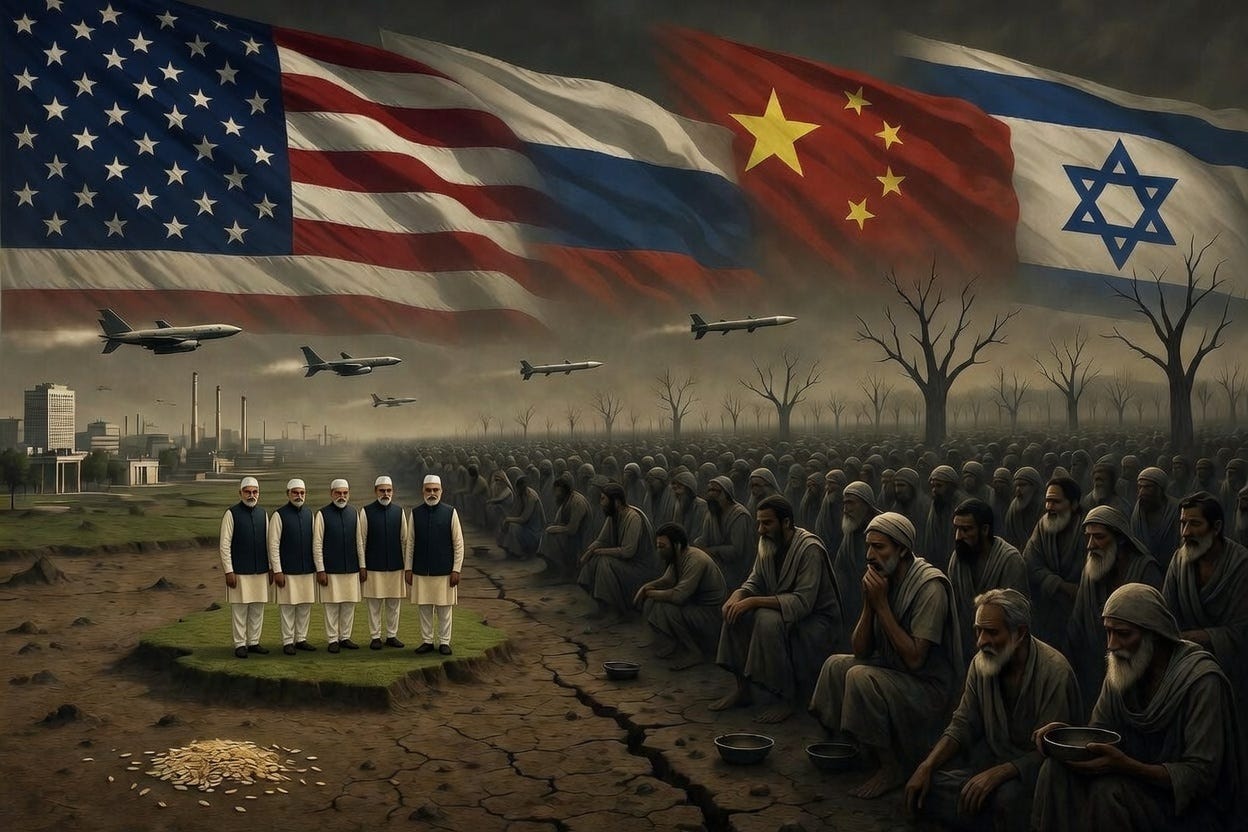
India’s Fence-Sitting Fiasco: Crony Gains, Starvation Risks, and BRICS Erosion
In the shadow of escalating global tensions, India stands at a crossroads, grappling with a series of policy decisions that prioritize elite interests and short-term geopolitical gains over the welfare of its 1.5 billion citizens.
Under Prime Minister Narendra Modi’s Bharatiya Janata Party (BJP) government, the nation has pursued a “schizophrenic” foreign policy—oscillating between alignments with the United States and Israel on one hand, and pragmatic ties to Russia, China, and the Global South on the other. This fence-sitting, driven by material contradictions like energy dependence and poverty risks, has not only eroded India’s credibility in multipolar forums like BRICS and the Shanghai Cooperation Organization (SCO) but also risks deepening internal inequalities. As Vijay Prashad, a prominent Indian historian and critic of US imperialism, has articulated in recent discussions, these choices reflect a hardened right-wing elite consensus that favors crony capitalism and Western appeasement, potentially leaving hundreds of millions behind in starvation and economic despair.
The Elite’s Grip: A Society Divided
At the heart of India’s challenges lies profound inequality. With hundreds of millions teetering on the brink of starvation—not mere poverty, but uncertainty about the next meal—India exemplifies a nation where scale amplifies deprivation.
A tiny elite, comprising just 1-2% of the population, controls land, industries, infrastructure, and exerts outsized influence over government. This elite has undergone a dramatic shift over the past 10-15 years: once divided between hard-right conservatives (favoring policing and gated communities to manage unrest) and liberals (advocating limited welfare to prevent rebellion), it has now hardened almost entirely toward the far right under Modi’s tenure.
This dialectical process—Modi empowering the elite, and the elite bolstering his politics—has marginalized liberals, collapsing social democracy and liberalism in India. Campaign finance tells the story: 80% of known funds flow to the BJP, a reversal from the historical 60-70% liberal dominance.
Public views, shaped by propaganda and intensified anti-Muslim rhetoric in media and politics, diverge sharply from elite priorities. While the masses aspire to upward mobility, the ruling class pursues policies that entrench their power, often at the expense of social welfare. Sections of the left and regional parties have stepped in to advocate redistribution, but the overall imbalance favors harsh, right-wing agendas.
Foreign Policy Flip-Flops: From Non-Alignment to Self-Sabotage
India’s post-independence foreign policy was rooted in non-alignment, seeking sovereignty and economic rebuilding through protectionism (e.g., the 1944 Bombay Plan). This allowed elites to secure the best deals from superpowers without full dependence. Liberalization in the 1990s, amid a balance-of-payments crisis, transformed elites into importers and subcontractors for foreign capital, but unlike China, India failed to demand technology transfers, resulting in joint ventures rather than global champions like Huawei.
Today, this legacy manifests in contradictory alignments. Geopolitically, enmities with Pakistan and China push India toward the US-led Indo-Pacific strategy and Quad. Normalization with Washington required routing through Tel Aviv, making India a top importer of Israeli arms (bypassing US restrictions post-1998 nuclear tests).
The BJP’s anti-Muslim sensibility aligned with the Global War on Terror, fostering ties with Israel. Yet, economic realities—near-total oil imports, refineries tuned to Russian crude—force continued reliance on subsidized Russian energy (processed and exported to Europe, laundering sanctions) and Gulf suppliers.
Recent events underscore this “schizophrenia”:
August 2025: Trump’s 50% tariffs on India sparked outrage and Modi’s Beijing outreach to mend China ties.
October 2025: US-India defense “reset.”
November 2025: Major US LPG deal under pressure to reduce Russian reliance.
December 2025: Putin’s “superstar” visit; Modi dubs Russia India’s “guiding star.”
February 2026: Tariffs cut to 18% after alleged $500 billion US goods pledge (mainly oil/gas); Russian imports halved to ~1 million barrels/day (Modi disputes firm commitment).
These flip-flops raise costs: US energy from afar is pricier than Russian/Iranian via the International North-South Transport Corridor (INSTC). China benefits by absorbing redirected supplies, bolstering its economy while India’s grows costlier. Prashad argues this isn’t principled non-alignment but material constraints—elites culturally can’t break from the West, yet poverty prevents full capitulation.
In West Asia, decisions are even more perilous. Recent UAE defense/gas/nuclear pacts align India with an Israel-UAE-Ethiopia-Somaliland bloc, pitting it against broader regional powers amid Gaza’s genocide. The India-Middle East-Europe Corridor (IMEC)—unfunded and fantastical—benefits Modi’s ally and billionaire oligarch Gautam Adani (port controller in Gujarat, Haifa) more than the nation. US demands to exit Iran’s Chabahar port by April 2026 (key to INSTC, with $150M+ Indian investment) threaten Central Asian access, rivaling China’s Gwadar. Abandoning it is “economically insane,” yet Modi appears to kick the can down the road.
The Toll on the Majority: Cronyism and Catastrophe
These policies favor the few—corporate cronies like Adani gain from “sweetheart” deals (e.g., EU-India FTA, US frameworks)—while imperiling the many. Implementation risks dairy price drops (15%, hitting 80 million farmers; ~$12 billion annual losses), cotton/soybean devastation, and soaring pharma costs (highest out-of-pocket globally). Massive arms imports (~$40 billion package in February 2026, including 114 French Rafale jets) waste resources amid starvation, cycling suppliers without strategic sense (e.g., Javelins irrelevant to modern conflicts).
Electorally, backlash looms: Maharashtra farmers’ losses could cost the right key states. Prashad warns no government tolerates mass famine—Modi’s limit is starvation events from fuel/food price spikes. Yet, elite cronyism persists, associating India with imperialism and genocide, tarnishing its Global South image (likened to Erdogan’s Turkey: untrustworthy).
Global Ramifications: BRICS Fallout and Iran’s Shadow
India’s tilts erode multipolar trust. Modi’s February 25-26, 2026, Knesset address—first by an Indian PM, pledging firm Israel support amid Gaza horrors—signals a destructive shift, confusing operational needs (Israeli arms) with strategic goals (Global South growth). BRICS/SCO, non-adversarial forums allowing enmities, face spoilers: India blocks BRICS bank progress; Russia ties downgrade to “transactional.” Epstein files reveal advice for Qatar to emulate India’s Israel “dance” for Trump favor, underscoring elite compromise.
Amid US-Iran tensions (Trump’s bluff, armada weaknesses), India would likely condemn an attack on sovereignty grounds, influenced by 120 million Muslims (largest Shia outside Iran) and left support (100 million). Yet, tunnel-visioned criteria (Pakistan/China enmities) may prevail over actual interests (peace, development).
A Difficult Outlook: Toward Rationality or Ruin?
India’s trajectory is precarious: bad decisions entrench elite power, exacerbate inequalities, and hinder Asia’s potential (e.g., stalled SCO dialogues, peace pipeline). Prashad and other Indian critics envision optimism in SCO/BRICS for harmonious development—win-win compromises over zero-sum dominance—but warn change requires internal shifts. Economic fallout may revive liberalism, conceding welfare to avert unrest, opening left space for radical agendas. Until elites grasp rationality—prioritizing poverty eradication over Western fantasies—India risks leaving its majority behind, trapped in a matrix of artificial realities while real infrastructure (Belt and Road) builds elsewhere.
As global blocs coalesce, India’s schizophrenia may force a choice: align with the Global South for survival, or persist in self-sabotage, favoring the few at the peril of the many. The world watches, popcorn in hand, as the stakes rise.
▪ ▪ ▪
Related:
Why India Can’t Catch Up to China—Yet
Rapid growth hasn’t closed the gap, but strategic partnerships could give India a turbo boost
On the Edge of the Abyss: India and Pakistan’s Escalating, Extremely Dangerous Standoff
A Terrorist Attack, Nuclear Threats and Diplomatic Rifts - is War Between Two Nuclear Powers Inevitable or Can Cooler Heads Prevail?
▪ ▪ ▪
Felix Abt is an entrepreneur, author and travel blogger, living in Asia.
With his articles, he tries to make a modest contribution to debunking the omnipresent propaganda of the mainstream media for those who don’t have the time (and that’s most people) to do the research to see through it.
Colonial mentality. The Indian Government can never be trusted.