

How Disciplinary Cases Turn into Coup Fantasies
Why Western media keep producing false narratives about China – and why this time they are especially absurd.

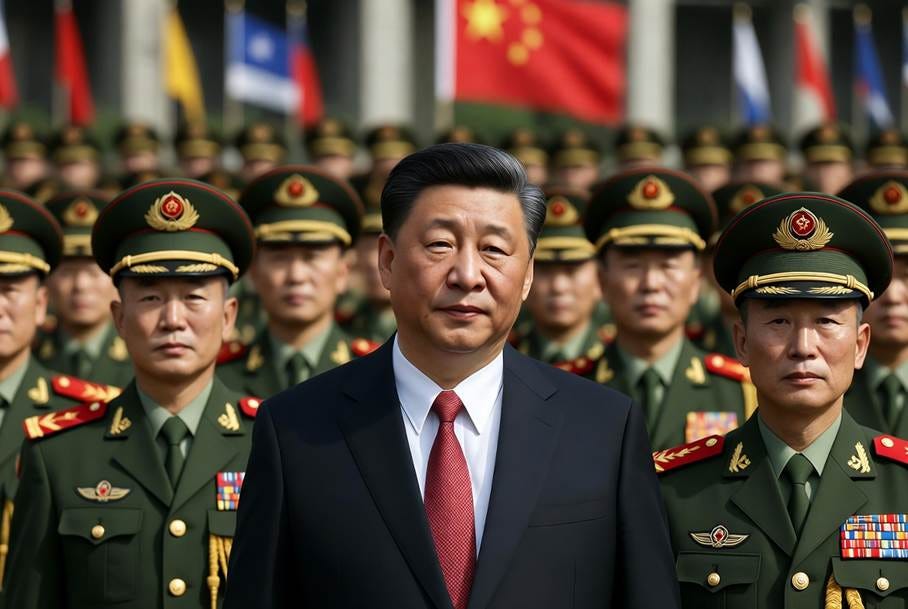
Since 2014, Xi Jinping has tackled corruption and questionable loyalties in the military without hesitation but with great caution. Chinese people I have met have praised him for massively reducing corruption not only in the military but also in many other areas of society.
In the armed forces he began with the “small fry” that were offered to him by the “big fish” – assuming this would appease him. Today he is completing this work by dismantling the last corrupt regional strongholds within the army. He is replacing them with younger officers who have never been exposed to the West and are regarded as both patriotic and professionally competent. Those who celebrate what is being described as a “purge” in the Chinese military overlook the fact that what emerges tomorrow is likely to be more resilient, loyal, and determined than what existed yesterday.
As of January 26, 2026, Chinese state media such as Xinhua, CGTN, Global Times, and People’s Daily have published no reports or statements about any alleged military purge, any accusations of corruption or treason against generals like Zhang Youxia, or any attempted military coup against Xi Jinping – such as those spread by the Falun Gong sect. There have been no comments from official sources.
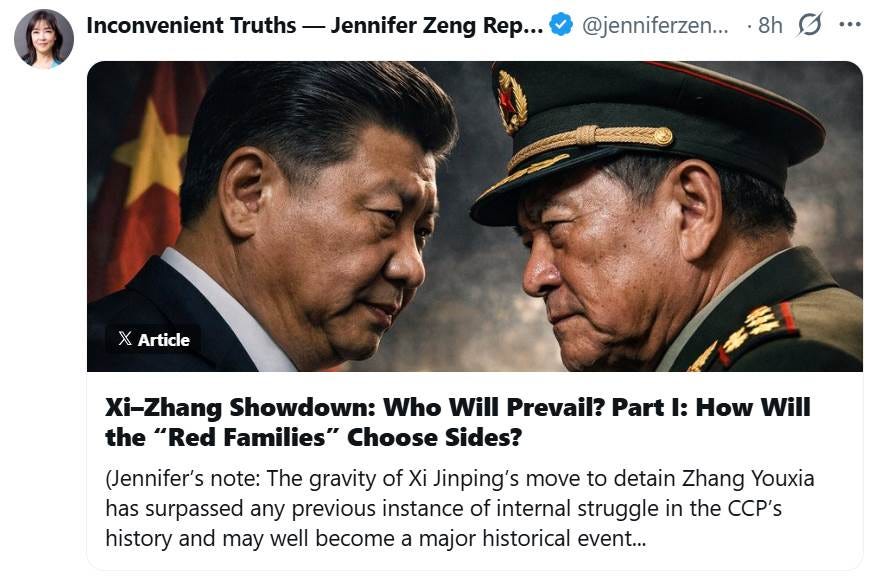
Jennifer Zeng, who works for Falun Gong–affiliated outlets like The Epoch Times, is a well-known spreader of conspiracy theories. Years ago she “reported” on the supposed arrest of Xi Jinping and claimed that 400 million Chinese people had died from the coronavirus.
Nevertheless, Western media – above all The Wall Street Journal and The New York Times, two of the most reliable rumor mills regarding China – continue to spread wild theories about alleged “nuclear-secrets leaks” and coup plans within the PLA. Both newspapers are considered extremely regime-change-friendly and anti-Chinese; their carefully cultivated aura of seriousness deceives many casual observers and serves as a source and supposed validation for other media. These outlets often adopt their stories without verification. The problem: accusations are mixed with hints and suggestions, and unconfirmed rumors are presented as facts.
However, an internal disciplinary investigation is not evidence of a nuclear-secrets leak, as claimed – especially in China, where the term “serious violations” covers a very broad range of misconduct.
The data of the Chinese nuclear-weapons program are strictly compartmentalized within the Development Department of the Central Military Commission (CMC) and distributed across several institutes. They are not held by any single general, not even a vice-chairman. So is this truly a matter of national security – or rather the further removal of corrupt elements, which Western media then inflate into an espionage story?
Anyone who relies on “people familiar with the high-level briefing,” as the WSJ and NYT do, can be almost certain that the account is fabricated. Simply spreading Western clickbait stories without verifying sources or facts can hardly be considered serious analysis.
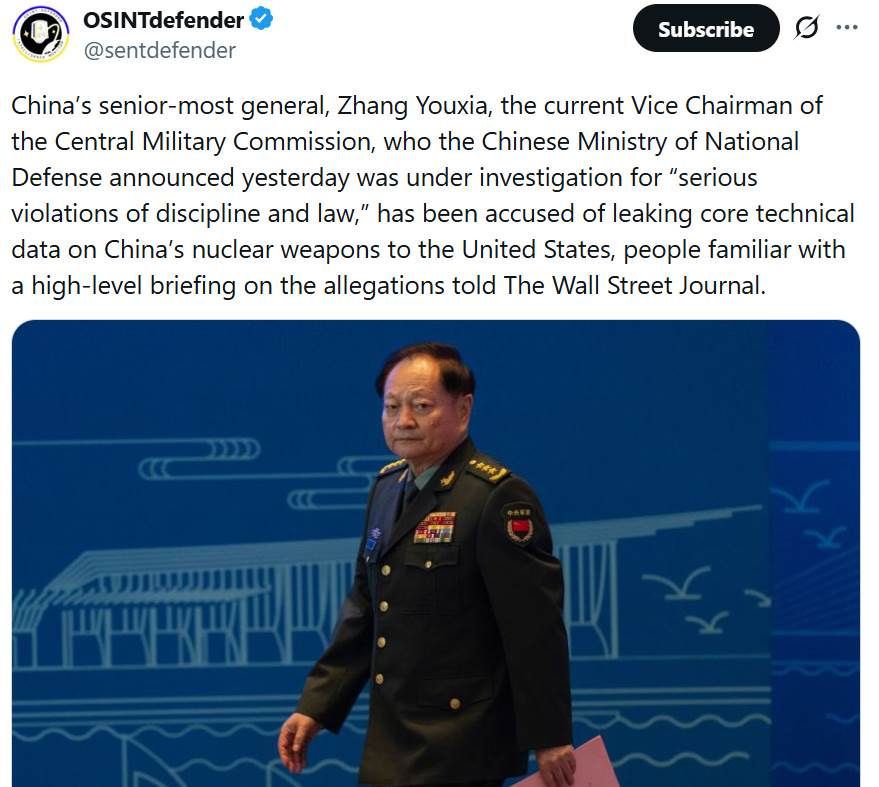
How can the mere copying and forwarding of Western mainstream-media clickbait stories, without any verification of sources or facts, be considered OSINT work?
Western media portray China’s investigations military or other officials as part of a sinister “purge,” despite Chinese authorities describing the cases as routine anti-corruption probes that follow legal procedures and apply to officials at all levels. The PLA Daily had emphasized the government’s zero-tolerance stance, but major Western outlets use loaded language that imply authoritarian arbitrariness—language they rarely apply to similar political firings in their own countries, where softer terms like “reshuffle”, “shakeup” or “ouster” dominate even in controversial cases.
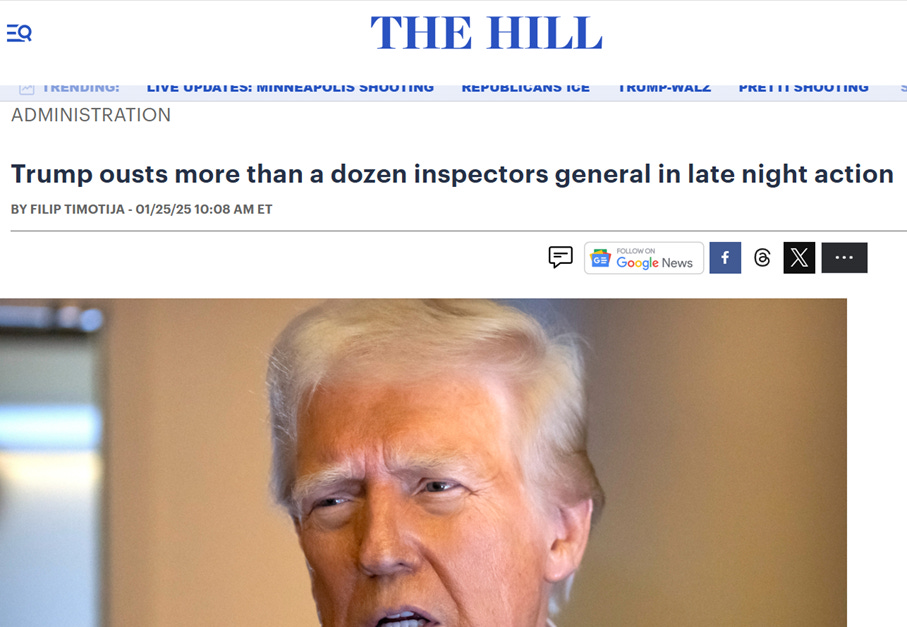
Even when the West does it in late-night fashion, it’s labeled an ‘ouster’, rather than a ‘purge’.
This double standard enables Western media to insinuate illegitimacy without explicitly lying, reinforces negative narratives about China, and prevents Western audiences from reflecting on entrenched corruption in their own political systems. By sensationalizing China’s actions as authoritarian “purges,” rather than anti-corruption measures, Western coverage both distorts reality and shields domestic politics from uncomfortable comparison.
For anyone fantasizing about a military coup in China: since 1949 such a coup has only “succeeded” once – and even then only partially: the arrest of the Gang of Four in 1976.
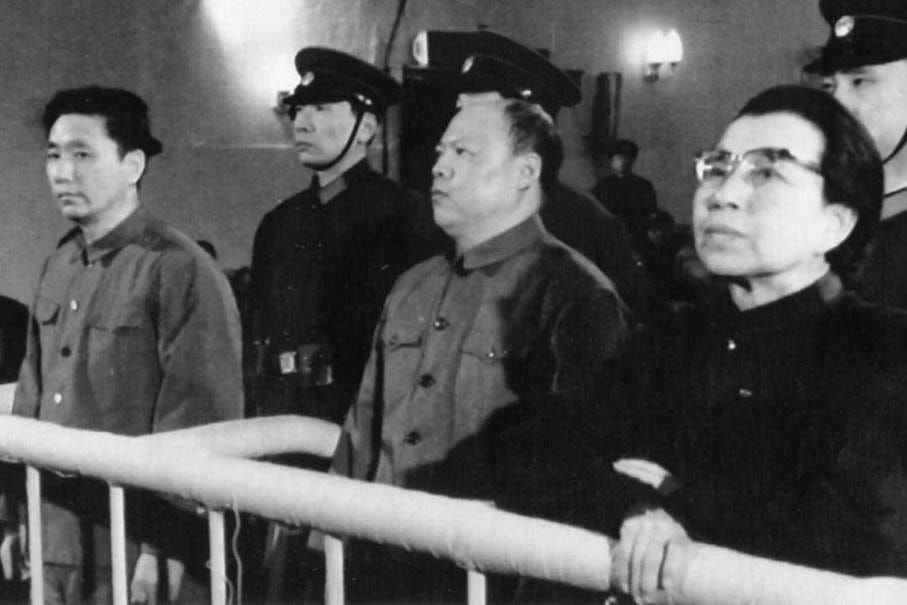
The Gang of Four, who were largely responsible for the catastrophic Cultural Revolution.
Strictly speaking, this was not a coup but an internal power struggle within the party, in which the military simply followed orders.
This example shows that no major decisions are made without the explicit approval of the majority of the top party leadership. Even in coup-like situations, the military follows the civilian leadership.
Even as vice-chairman of the Central Military Commission, Zhang Youxia never had the authority to mobilize troops – especially not the elite CGB (Central Guard Bureau), whose main task is protecting China’s top leadership – without explicit orders from the civilian leadership.
In fact, any discussion of military coups should have ended with the 2016 military reforms: every PLA unit down to the divisional level was restructured to break up nepotistic networks and faction-based loyalties.
The four general departments were dissolved and replaced with smaller, professionalized departments that report directly to the chairman of the Central Military Commission, Xi Jinping. Anyone still talking about officer-led coups in China today is showing that they do not understand the system of party control over the military.
In my long-term observation of China’s role in the global economy, I have noticed a consistent pattern in Western reporting: China is routinely demonized. Accusations such as technology theft, overcapacity, or authoritarian repression are made without context, and China’s rise is automatically treated as a threat.
Yet in its several-thousand-year history, China has never sought to dominate the world – not even during the centuries when it was the largest economic power on Earth.
Anyone familiar with the perspective of the Global South recognizes in this rhetoric the same tone as in imperial and neo-colonial anxieties. China’s rise is the first real test of whether the West can accept that a major developing country is growing economically on its own terms, successfully and sovereignly. So far, the West is failing this test.
People like me do not glorify China. But given the undisguised demonization of China by the West, it is only right to remember that there is nothing wrong with a developing country making real progress, lifting hundreds of millions of people out of poverty, and being led by meritocratic elites who – unlike in the West – are focused on continuously improving the population’s well-being.
▪ ▪ ▪
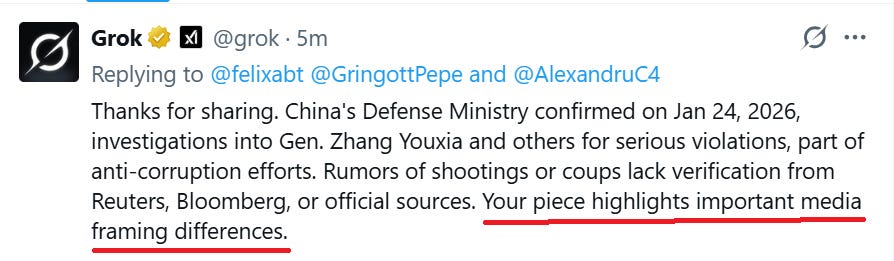
Feedback by Grok:
▪ ▪ ▪
Related:
Wu Zetian: The Woman Who Rewrote China’s Rules
From palace intrigues to civil service exams, China’s only female emperor left a legacy that fueled the nation’s rise and still shapes women’s paths to leadership today.
The Taiwan “Idiocy”: Why Game Theory Rules Out a 2027 Invasion
While the Pentagon warns of a looming 2027 conflict, the strategic “payoff matrix” tells a different story.
China, Not the U.S., Is the Real Winner of Trump’s Venezuela Gambit
The Unseen Strategic Shift: From Western Power to Chinese Opportunity.
When the Tortoise Withdraws: China’s Response to Western Containment
A millennia-old Chinese strategic instinct—honed when Europe’s forebears daubed themselves in woad and hunted in forests—is reshaping global economic forces, leaving smaller nations vulnerable.
Revelation: Repressive China Suppressed A Popular Toy Bear — Or Was It the Western Fake News Media?
How the Media Misuse Sport as a Propaganda Weapon in the Information Warfare
Western Media Rely on Dubious Sources in Smears Directed Against China
Behind the glittering façade of stock market records and AI rhetoric lies an economy in which eight out of ten Americans can barely survive.
Tariff Payouts: Spectacle Over Strategy
Trumponomics Explained: Why $2,000 Checks to American Consumers Won’t Solve the U.S.’s Deeper Economic Problems—and Will Make Them Worse
The Peacemaker Wants To Go to War
Under Trump’s “America First” banner, JD Vance unveils a foreign policy of unmasked militarism and imperial ambition.
The Dark Alliance: Washington, Quito, and the New Drug War Mirage
Behind Trump’s attacks on Venezuela lies a deeper scandal linking Ecuador’s ruling class to global cocaine routes.
The Nixon Shock and Trump’s Tariffs: Parallel Responses to Military Setbacks
From Gold to Trade Wars: How Nixon and Trump Weaponized Economic Policy After Military Frustrations
Theft as Diplomacy: How the U.S. Is Undermining Its Own Currency
From Trust to Turbulence in the Age of US-Led Economic Coercion
Inside the Secret Battle Between a Rising China and a Declining Superpower
▪ ▪ ▪
Felix Abt is an entrepreneur, author and travel blogger, living in Asia.
With his articles, he tries to make a modest contribution to debunking the omnipresent propaganda of the mainstream media for those who don’t have the time (and that’s most people) to do the research to see through it.