

Eight Consecutive Years Without a Passed Audit — and the Pentagon Gets a 50% Raise
Trump ignores his voters’ economic pain while showering billions on the war-profiteering class

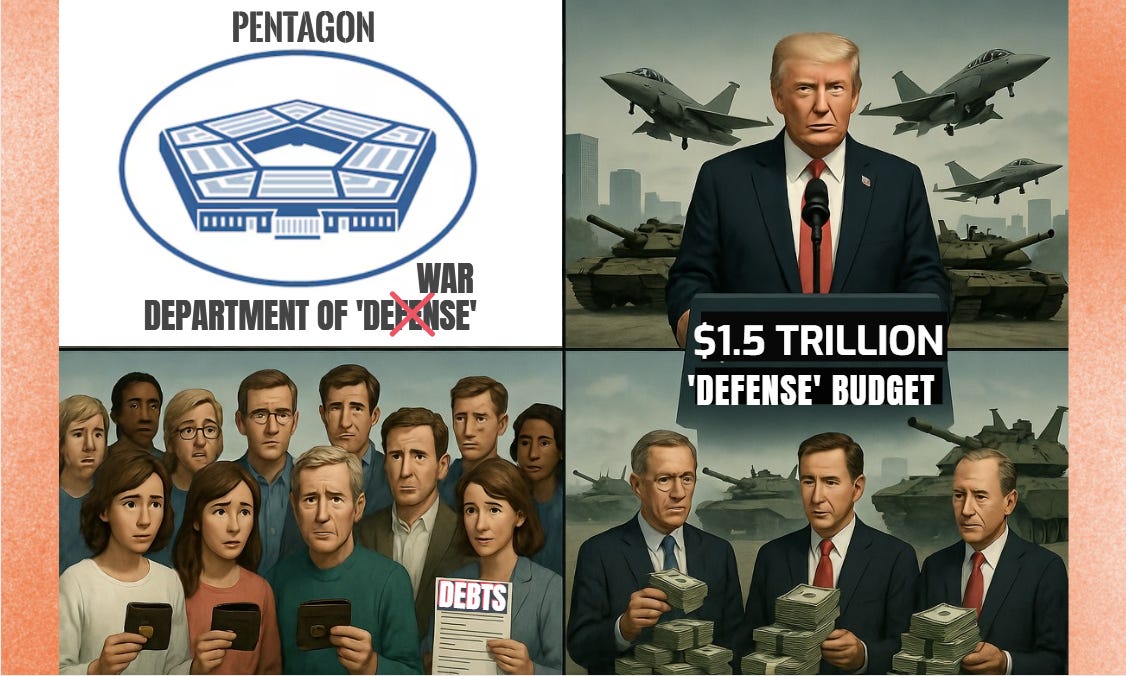
The Only Government Agency That Can’t Pass an Audit — and Is Rewarded for It
The Pentagon has now failed its annual financial audit for eight consecutive years — since Congress mandated these reviews in 2018, the Department of Defense (DoD) has never received a clean audit opinion. This makes it the only major federal agency with such a dismal record.
The most recent audit for fiscal year 2025 (released in December 2025) identified 26 material weaknesses and two significant deficiencies in internal controls over financial reporting. These issues highlight systemic problems in tracking assets, liabilities, and transactions across a sprawling bureaucracy that manages approximately $4.7 trillion in assets and a similar amount in liabilities — spread across all 50 states and more than 40 countries.
If Wall Street Did This, People Would Go to Jail
A prominent example involves the Joint Strike Fighter (F-35) program, where auditors were unable to properly account for assets in the global spare parts pool — leading to material misstatements that undermine the reliability of the department’s financial statements.
In the private sector, repeated failures of this kind would trigger severe regulatory consequences. But the massive structure of the former Department of Defense — now aptly called the Department of War — and its lucrative contracts with auditing firms allow the process to continue unchecked, despite repeated warning signs.
A Budget Explosion Built on Fear, Not Facts
Against this backdrop of unaccountability, President Donald Trump’s proposal — announced on Truth Social on January 7, 2026 — for a $1.5 trillion defense budget in fiscal year 2027 is all the more striking. The plan represents an increase of roughly $500–600 billion (about 50–66%) over the current 2026 baseline of around $900–901 billion (Congress-authorized, with additional funds pushing some estimates close to $1 trillion).
Trump presented the budget surge as essential for building his “Dream Military,” invoking threats from China, Russia, and Iran — countries that have no intention of attacking the United States. Realistically, the finger points more in the opposite direction.
Congress Cheers, Defense Contractors Celebrate, Taxpayers Brace
The proposal quickly gained support from neoconservative hardliners on Capitol Hill, including Senate Armed Services Committee Chairman Roger Wicker (R-MS) and House Armed Services Committee Chairman Mike Rogers (R-AL). Both praised it as necessary to rebuild the military, accelerate modernization (including shipbuilding and aircraft production), and raise U.S. defense spending to 5% of GDP (up from roughly 3.3–3.5% in recent years).
Trump suggested tariff revenues could fund the increase, though experts note that existing tariffs fall far short and warn that it could add $5–5.8 trillion to the national debt over the next decade (including interest).
He Campaigned on Everyday Problems — Now He’s Funding a “Golden Dome”
President Donald Trump was elected in 2024 by voters deeply frustrated with skyrocketing grocery prices, mounting credit card debt, unaffordable healthcare, crumbling infrastructure, and widespread anger over exorbitant military spending and endless foreign wars. These pocketbook and quality-of-life issues dominated voter concerns, with the economy consistently ranking as the top priority in pre-election polls.
Yet this dramatic increase — funding ambitious, extremely costly projects like the Golden Dome missile defense system (a nationwide shield, far larger than Israel’s Iron Dome and heavily questioned by military experts regarding its effectiveness) as well as a revitalized navy with new ship classes — stands in stark contrast to the actual priorities of voters.
Many of his supporters, already struggling with the highest cost of living of their lives (polls show a large portion of 2024 Trump voters describe affordability as the worst they have ever experienced), now face the prospect of trillions in new debt to fund an unprecedented military expansion. Social programs are likely to shrink, while the defense industry and massive military projects rake in billions — and once again, ordinary Americans foot the bill.
When War Profiteers Win, Working Americans Lose
Defense stocks surged following the announcement (despite Trump’s criticism of some contractors), delivering huge profits to war profiteers — while offering no immediate relief to ordinary Americans burdened by rising living costs. This move appears to hand a massive windfall to defense contractors and war profiteers — while doing nothing to ease the daily struggles of the population. It raises a pointed question: Is this really “America First,” or are military ambitions and foreign wars being prioritized over the urgent needs of voters who demanded change?
Defense Spending — or a Wealth Transfer to the Military-Industrial Complex?
The discrepancy is downright grotesque: voters demanded an end to wasteful spending abroad and relief at home — yet this proposal cements exactly the perpetual war spending they opposed, while vital priorities like healthcare, infrastructure, and economic security for working families are sidelined. In short: citizens suffer, the defense industry profits.
Before Asking for Trillions More — Why Not Pass a Single Simple Audit?
Why demand an unprecedented budget increase without first requiring the Pentagon to demonstrate basic financial transparency? A clean audit only requires sound accounting, transparent records, and effective controls — standards every major corporation and taxpayer must meet. Secretary of Defense Pete Hegseth promises a clean audit by 2028, yet eight consecutive failures point to deep, unresolved problems — clearly no obstacle to more billions.
History Is Clear: Massive Rearmament Means Permanent Tax Hikes
Historical patterns of military expansion show predictable outcomes: rapid debt accumulation followed by permanently higher taxes that rarely reverse. Studies of past rearmament periods (including NATO’s current European buildup, one of the largest in 150 years) indicate that even a decade after peak spending, tax revenues often remain 20–30% above pre-expansion levels. Taxpayers bear the long-term burden, with future generations inheriting the fiscal legacy.
Trillions for Missiles, Pennies for Schools, Cities, and Healthcare
If the U.S. is not preparing for a large-scale conflict — why normalize trillion-dollar budgets while pressing domestic issues like the opioid crisis, urban violence, healthcare, education, and infrastructure remain severely underfunded? An annual increase of over $500 billion will crowd out investments that directly improve Americans’ quality of life.
A Military Built on Debt — and a Future Built on Sacrifice
This is not merely a budget debate; it’s about national priorities, power, and the future shape of government. A $1.5 trillion defense budget would redefine “normal” in an era of permanent crisis, entrench militarization, and do so at the expense of accountability and domestic well-being. Until the Pentagon can pass even a basic audit, calls for such dramatic expansion deserve intense scrutiny from the taxpayers who ultimately pay the steep price.
▪ ▪ ▪
Related:
Behind the glittering façade of stock market records and AI rhetoric lies an economy in which eight out of ten Americans can barely survive.
Tariff Payouts: Spectacle Over Strategy
Trumponomics Explained: Why $2,000 Checks to American Consumers Won’t Solve the U.S.’s Deeper Economic Problems—and Will Make Them Worse
How the destruction of Epstein evidence and the sudden Venezuela crisis shifted focus from elite complicity to regime change in Latin America
The Peacemaker Wants To Go to War
Under Trump’s “America First” banner, JD Vance unveils a foreign policy of unmasked militarism and imperial ambition.
The Dark Alliance: Washington, Quito, and the New Drug War Mirage
Behind Trump’s attacks on Venezuela lies a deeper scandal linking Ecuador’s ruling class to global cocaine routes.
The Deal That Never Was: Washington Proposed, Moscow Agreed – and Trump Blocked It
A ceasefire in Zaporizhzhia and Kherson, with Ukraine’s Donbass withdrawal, was on the table – but Washington pulled back at the last moment.
The Nixon Shock and Trump’s Tariffs: Parallel Responses to Military Setbacks
From Gold to Trade Wars: How Nixon and Trump Weaponized Economic Policy After Military Frustrations
Theft as Diplomacy: How the U.S. Is Undermining Its Own Currency
From Trust to Turbulence in the Age of US-Led Economic Coercion
Inside the Secret Battle Between a Rising China and a Declining Superpower
▪ ▪ ▪
Felix Abt is an entrepreneur, author and travel blogger, living in Asia.
With his articles, he tries to make a modest contribution to debunking the omnipresent propaganda of the mainstream media for those who don’t have the time (and that’s most people) to do the research to see through it.
▪ ▪ ▪